CISE & the Knowledge Foundation
Trusted external industry material and permitted organizational knowledge provide context. Sources, freshness and verification status matter, and private tenant data is kept within its boundaries.
TECHNICAL ARCHITECTURE
Ceryvra is being engineered as a modular, multi-tenant decision-intelligence platform with one governed foundation across industries. The architecture separates organizational context, knowledge, decision reasoning, authorization, execution and independent verification.
Technical buyers can evaluate how information enters the system, where authority is enforced, how supported integrations act, and what evidence is required before the platform learns from a result.
CAPABILITY MAP
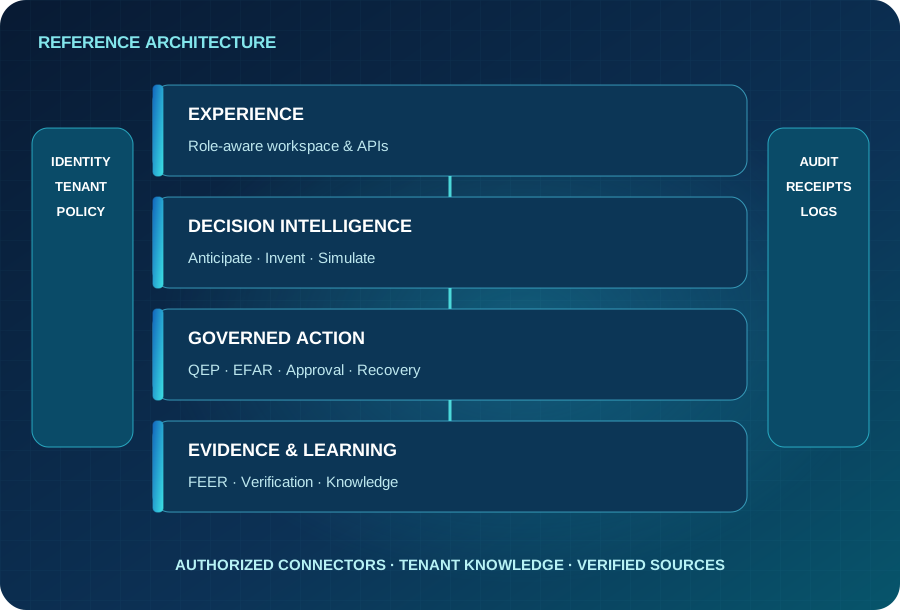
A high-level description of intended responsibilities—not a declaration that every connector or engine has completed commercial acceptance.
Trusted external industry material and permitted organizational knowledge provide context. Sources, freshness and verification status matter, and private tenant data is kept within its boundaries.
A shared role-aware experience draws on organizational context to understand, anticipate, invent and simulate options. The system presents uncertainty and rationale, rather than silently deciding for people.
QEP provides the governed execution lifecycle. EFAR addresses execution failure, recovery and evidence of what did or did not complete; neither bypasses delegated authority or policy.
Independent checks look beyond task completion to confirm what happened. Evidence-backed results can inform the next decision; unsupported success claims must not be promoted to verified learning.
FOUNDATIONAL CONTROLS
Identity and authorization, tenant isolation, the AI gateway, audit records and supported system connectors sit across the workflow. In the intended modular service design, a shared Core owns policy decisions and authorized execution; industry layers add contextual knowledge rather than duplicating core security.