
TRUST & ACCOUNTABILITY

Intelligence needs guardrails.
And proof.

Organizations should be able to benefit from powerful AI without giving up control of sensitive information or business decisions. Ceryvra’s intended approach starts with clear identity, tenant boundaries, delegated permissions and defined responsibilities.

Just as importantly, an AI-generated recommendation is not treated as an approval, an executed task or an independently verified outcome. Those events are deliberately kept separate.

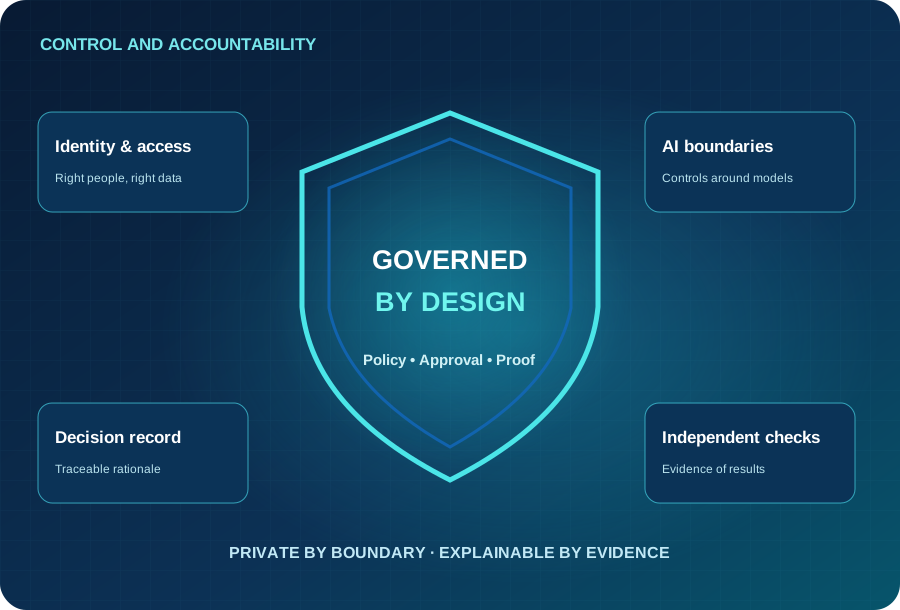
Security and accountability diagram with identity, governance, audit and verification

FOUR FOUNDATIONS

Trust must be designed into every decision.

These are the engineering controls the platform is being designed around, with deployment-specific configuration and testing required before relying on them in production.

01

Identity & access

Users, integrations and delegated administrators receive permissions appropriate to their role. Tenant isolation and least-privilege access are intended to prevent one organization’s information or authority from crossing into another.

02

Governed AI & actions

AI requests follow defined policies and data-sharing boundaries. Recommendations must pass required checks and approvals before any supported external action is allowed to run.

03

Evidence & accountability

Important decisions carry a traceable explanation of the evidence considered, authority applied and actions taken. A generated answer does not become organizational truth merely because it sounds confident.

04

Independent verification

Execution and success are different claims. The platform is designed to check relevant outcomes through separate evidence, flag failed checks and avoid declaring an improvement verified without sufficient proof.

What happens when something fails?

The intended response is to stop or constrain unsafe actions, preserve an understandable record, route issues to authorized people and support controlled recovery where it is possible. Exact safeguards must be proven through security and integration acceptance tests.